Why Property That Moves Needs Its Own Policy
Contractors tools and equipment insurance is a form of inland marine coverage — the line insurers use for property that travels rather than sitting at one fixed address. In the field it is usually called a contractors equipment floater, because the coverage floats along with your gear from the shop to the truck to the jobsite and back.
This is the gap most contractors do not see until a claim gets denied. A commercial property policy covers a building and the contents at that scheduled location — leave the address and the coverage stays behind. General liability covers injuries and damage you cause to other people and their property, not your own compressor when it walks off a jobsite. Neither one pays to replace your own tools when they are stolen from the truck or crushed under a collapsed scaffold three counties away.
The one-sentence version
General liability protects the people around your work; a building policy protects a fixed address; the equipment floater protects your own tools wherever they happen to be working that day. You need all three because they cover completely different things.
For a Colorado contractor, the floater is what keeps a bad night in a job trailer from turning into a bad quarter. Replace $18,000 of stolen tools out of pocket and the jobs you cannot finish cost even more than the gear.
Small Tools vs. Large Scheduled Equipment
Every equipment floater splits your gear into two buckets, and understanding the split is how you avoid being underinsured on the day it matters.
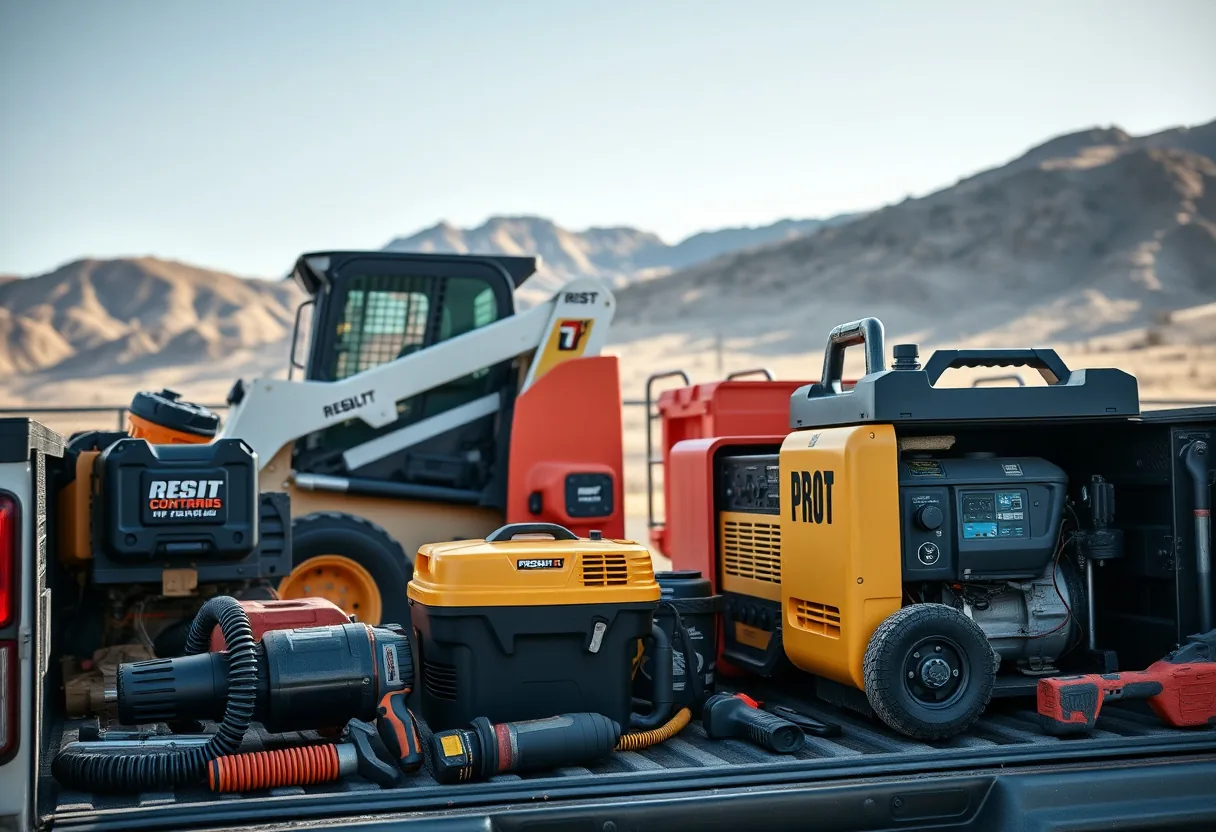
Small tools are covered under a blanket, unscheduled limit — a single pool of coverage for everything under a per-item cap (commonly $1,000 to $2,500 each). Drills, saws, nailers, grinders, levels, hand tools, generators-you-carry: you do not list them individually. You pick a blanket limit that reflects the full replacement value of everything in the truck and the trailer, and the policy pays out of that pool up to the per-item cap.
Large equipment is scheduled — listed individually by make, model, year, serial or VIN, and stated value. Skid steers, mini excavators, backhoes, towable compressors, large generators, light towers, and equipment trailers all belong here. Anything above the small-tool per-item cap should be scheduled by name so there is no argument about value at claim time.
| Small tools (blanket) | Large equipment (scheduled) | |
|---|---|---|
| How covered | One unscheduled limit, per-item cap | Listed individually by serial/VIN and value |
| Typical items | Drills, saws, nailers, hand tools, small generators | Skid steers, excavators, compressors, light towers, trailers |
| You provide | A total blanket limit and per-item cap | Make, model, year, serial number, stated value |
| Claim payout | Up to the per-item cap from the blanket pool | The scheduled stated value (ACV or replacement cost) |
The classic mistake: buying a $10,000 blanket limit with a $1,500 per-item cap and assuming the $40,000 mini-ex parked at the site is covered. It is not — unscheduled equipment over the cap falls through the crack. Schedule the big stuff.
Leased, Rented & Borrowed Equipment
You do not have to own a machine to be on the hook for it. When you rent a skid steer from a Colorado rental yard or borrow a compressor from another contractor, you are financially responsible for damage, theft, and sometimes loss-of-rental-income while it is in your care. A rented excavator that gets stolen off your site is your bill, not the rental yard's.
This is why rental yards require proof of coverage before the keys leave the counter. Many contractors default to the yard's expensive daily damage waiver — an equipment floater endorsement for rented, leased, and borrowed equipment usually costs far less and covers the same exposure across every rental you take all year.
- Rented equipment — machines you rent by the day, week, or month from a yard
- Leased equipment — longer-term leases where you may still carry physical-damage responsibility
- Borrowed equipment — a peer's machine in your care, custody, and control on your job
- Loss of use / rental charges — the fees a yard bills while a damaged unit is out of service
Set the rented-equipment limit to the most expensive single unit you would ever rent, not the average. One day with a $95,000 telehandler on a $25,000 rental limit is a $70,000 hole. Confirm the limit before you sign the rental contract, not after the machine tips over.
The Colorado Theft & Weather Reality
Colorado stacks two of the biggest equipment-loss drivers in the country: theft and hail. An equipment floater is one of the few policies that answers to both.
Jobsite and truck theft is a leading cause of contractor loss nationwide, and the Denver metro runs high for construction-equipment and tool theft. Open sites, unattended trailers overnight, and gear left in trucks are soft targets. Colorado has also been a national hotspot for catalytic-converter theft off work trucks, and trailer theft — an unhitched enclosed trailer full of tools rolled away in minutes — is a recurring, expensive claim.
- Jobsite theft — tools and machines taken from open or fenced sites, especially overnight and on weekends
- Truck & van break-ins — smash-and-grab of tools left in the vehicle
- Catalytic-converter theft — a Colorado-heavy loss that sidelines the truck itself
- Trailer theft — the whole enclosed trailer and everything in it, gone in minutes
Then there is the sky. Colorado's Front Range hail does not just dent siding — it destroys equipment. Hail cracks light-tower lenses, shreds compressor cores, dents fuel tanks and cabs, and totals gear staged in the open along the Palmer Divide and the northern Front Range hail alley. A special (all-risk) form floater treats hail as a covered peril; a bare named-perils form may not. In this state, that distinction is not academic.
Cut your theft exposure and your premium
Record serial numbers, photograph high-value tools, lock trailers with hitch and coupler locks, use GPS trackers on machines, and pull small tools out of the truck overnight when you can. Documented anti-theft habits reduce claims and give underwriters a reason to price you better.
How the Coverage Is Written: Perils, Valuation & Deductibles
Two policies with the same limit can pay wildly different amounts on the same loss, because the fine print is where equipment floaters actually differ. Read these three settings before you buy.
Named-perils vs. special (all-risk) form. A named-perils form only pays for causes it specifically lists — fire, theft, collision, and a handful of others. A special form (also called all-risk) covers any cause of loss except those it explicitly excludes, which is broader and the better fit for equipment exposed to Colorado weather and jobsite chaos.
ACV vs. replacement cost. Actual cash value (ACV) pays what the item was worth used — replacement cost minus depreciation — so a five-year-old saw pays out at used-saw money. Replacement cost value (RCV) pays what a new equivalent costs today, with no depreciation haircut. RCV costs more in premium and is worth it on gear you would have to replace new to keep working.
Deductibles apply per occurrence — a single theft of ten tools is usually one deductible, not ten. A higher deductible lowers premium but means small losses come out of pocket; match it to what you can absorb without pain.
How to value your inventory: walk the truck, the trailer, and the shop and build a line-item list — item, model, serial number, purchase date, and current replacement price. Photograph everything. Total the small tools to set your blanket limit; schedule anything over the per-item cap. That inventory is both how you buy the right limit and how you prove a claim fast when gear disappears.
What the Equipment Floater Does NOT Cover
An equipment floater is broad, but it is not a warranty and it is not a catch-all. The common exclusions:
- Wear and tear — gradual deterioration, rust, and corrosion are maintenance, not a covered loss
- Mechanical or electrical breakdown — a blown hydraulic pump or fried motor from internal failure (not an external peril) is on you unless you add breakdown coverage
- Employee-owned tools — many policies cover only tools the business owns; a worker's personal drills may need a specific endorsement
- Mysterious disappearance — some forms exclude items that simply go missing with no evidence of theft
- Equipment being road-registered vehicles — a licensed truck is a commercial auto exposure, not equipment
- Faulty workmanship and installed materials — materials built into a project belong under builders risk, not the floater
The overlaps matter. Materials being installed into a structure are a builders risk claim, and a tool falling off your truck on the highway is a commercial auto question. The floater's lane is your own movable tools and machines — know where its edges are before you need it.
Get a Colorado Tools & Equipment Quote
We write contractors equipment floaters for Colorado trades all day — one-truck handymen with a blanket small-tool limit, and site-work outfits scheduling skid steers, excavators, and towable compressors on a special form with replacement-cost valuation. Rented-equipment endorsements to satisfy the rental yard are a same-visit add.
Have your tool inventory, the serial numbers and stated values on your big machines, and the priciest unit you rent ready, then get a quote — or call 844-967-5247 and talk to someone who knows the difference between a blanket limit and a scheduled one. For how equipment coverage fits the rest of your program, see our Colorado contractor insurance cost guide.